

Introduction
The rapid rise of artificial intelligence and automation has transformed how companies operate, compete, and grow. Businesses across the United States are searching for practical ways to reduce costs, improve efficiency, and eliminate repetitive work. As a result, interest in droven.io rpa and business automation has increased significantly among business owners, entrepreneurs, students, and technology professionals.
At its core, droven.io rpa and business automation refers to educational content that explains how Robotic Process Automation (RPA), artificial intelligence, and digital transformation can improve business operations. Rather than selling automation software, Droven.io functions primarily as an information and technology education platform that helps readers understand emerging technologies and their real-world applications.
For organizations exploring automation opportunities, understanding these concepts is essential. Companies that successfully implement automation often experience increased productivity, reduced operational costs, improved accuracy, and better customer experiences. This article explores the fundamentals of RPA, business automation, artificial intelligence integration, and how Droven.io helps explain these technologies in a clear and accessible way.
What Is droven.io RPA and Business Automation?
When people search for droven.io rpa and business automation, they are typically looking for information about how Droven.io explains automation technologies and business process optimization. Droven.io is positioned as an educational platform focused on artificial intelligence, automation, machine learning, robotics, digital transformation, and future technology trends.
The platform publishes informational content designed to simplify complex technological concepts. Instead of acting as a software vendor, it provides educational resources that help readers understand how businesses use automation technologies to streamline operations and improve efficiency. This approach makes the content valuable for both technical and non-technical audiences.
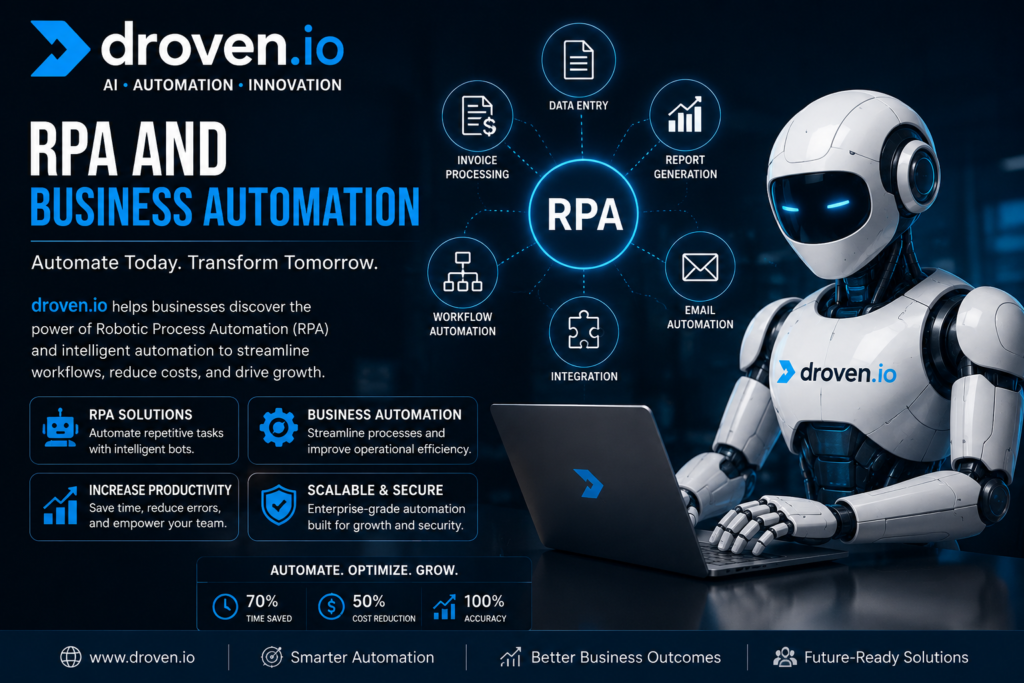
Business automation itself refers to the use of technology to perform repetitive processes with minimal human intervention. These automated workflows can include data entry, invoice processing, report generation, customer communication, and document management. By automating routine activities, businesses can focus more resources on strategic growth and innovation.
Understanding Robotic Process Automation (RPA)
droven.io rpa and business automation: Robotic Process Automation, commonly known as RPA, is a technology that uses software bots to automate repetitive, rule-based tasks that humans typically perform on computers. These bots can interact with applications, enter data, move files, generate reports, and complete other routine activities without constant human supervision.
RPA has become increasingly popular because it offers a practical way to improve efficiency without requiring organizations to replace their existing software systems. Instead of redesigning entire infrastructures, companies can deploy bots to handle repetitive processes while employees focus on higher-value activities. Research on RPA highlights its ability to automate high-volume routines and improve operational consistency.
Many organizations begin their automation journey by identifying processes that consume significant time and resources. Common candidates include invoice management, employee onboarding, payroll administration, compliance reporting, and customer support workflows. Once automated, these processes often become faster, more accurate, and easier to scale.
How droven.io Explains Business Automation
droven.io rpa and business automation: One reason Droven.io has attracted attention is its focus on simplifying technical topics for broader audiences. The platform breaks automation concepts into understandable stages, helping readers learn how automation projects move from idea to implementation. According to its content, automation generally begins with identifying repetitive tasks that consume significant business resources.
The educational approach emphasizes practical understanding rather than technical complexity. Readers learn how workflows are mapped, how bots are trained to perform tasks, and how organizations monitor automated processes after deployment. This step-by-step explanation makes automation more approachable for business leaders who may not have technical backgrounds.
Additionally, the platform connects automation discussions with broader digital transformation strategies. Rather than viewing automation as an isolated technology, it presents automation as part of a larger effort to modernize business operations and improve competitiveness in a rapidly evolving marketplace.
Key Benefits of RPA for Modern Businesses
droven.io rpa and business automation: One of the primary advantages of RPA is increased productivity. Software bots can operate continuously without breaks, allowing organizations to complete tasks faster than traditional manual methods. This capability helps businesses process larger workloads while maintaining consistent performance levels.
Accuracy is another major benefit. Human errors can occur during repetitive tasks, especially when employees handle large volumes of information. Automation reduces the likelihood of mistakes by following predefined rules consistently. This reliability is particularly valuable in industries such as finance, healthcare, insurance, and logistics where accuracy is essential.
Cost reduction also plays a significant role in automation adoption. By reducing manual effort, organizations can allocate resources more effectively and improve operational efficiency. Businesses often use automation to support growth without proportionally increasing staffing requirements.
Furthermore, automation can improve employee satisfaction. When repetitive work is automated, staff members have more opportunities to focus on creative problem-solving, strategic planning, customer relationships, and innovation-driven projects.
Common Business Processes That Can Be Automated
Many organizations begin automation efforts with administrative tasks. Data entry remains one of the most common use cases because it is repetitive, time-consuming, and highly structured. Automated systems can transfer information between applications quickly and accurately.
Invoice processing is another area where automation delivers measurable benefits. Bots can capture invoice data, validate information, route approvals, and update accounting systems. This reduces processing times while improving financial accuracy and compliance.
Customer service operations also benefit from automation. Businesses increasingly use automated workflows to handle appointment scheduling, ticket routing, email responses, and customer data management. These improvements help organizations provide faster and more consistent customer experiences.
Human resources departments frequently automate onboarding, employee record management, payroll support, and benefits administration. These applications demonstrate how automation extends across nearly every business function.
The Connection Between AI and RPA
Modern automation increasingly combines artificial intelligence with traditional RPA capabilities. While basic RPA excels at rule-based tasks, AI enables systems to process unstructured information, recognize patterns, and make intelligent decisions. Researchers describe this evolution as Intelligent Process Automation (IPA), which expands automation capabilities beyond simple task execution.
Artificial intelligence enhances automation by introducing technologies such as natural language processing, machine learning, computer vision, and predictive analytics. These capabilities allow automated systems to interpret documents, analyze customer communications, and respond to changing business conditions.
Droven.io frequently discusses the relationship between AI and automation because these technologies increasingly work together. Businesses that understand both concepts are better positioned to evaluate future technology investments and digital transformation opportunities.
As AI capabilities continue advancing, organizations can expect automation systems to become more adaptive, intelligent, and capable of handling complex workflows that previously required human judgment.
How Small Businesses Can Benefit from Automation
Automation is no longer limited to large enterprises with extensive technology budgets. Small businesses increasingly adopt automation solutions to improve efficiency and compete more effectively in their markets. Many automation tools are now accessible, scalable, and affordable for growing organizations.
For small businesses, automation can streamline marketing campaigns, customer relationship management, accounting processes, inventory tracking, and lead generation activities. These improvements free business owners to focus on growth strategies and customer engagement.
Another significant advantage is scalability. As organizations grow, manual processes often become bottlenecks. Automation allows companies to handle increased workloads without proportionally increasing operational complexity. This flexibility is particularly important for startups and rapidly expanding businesses.
Educational platforms like Droven.io help smaller organizations understand these opportunities by providing accessible explanations and practical examples of automation in action.
Challenges and Limitations of Business Automation
Despite its benefits, automation is not a universal solution. Organizations must carefully evaluate processes before implementing automation technologies. Not every task is suitable for automation, particularly those requiring significant creativity, emotional intelligence, or complex decision-making.
Implementation challenges can also arise when organizations lack clear process documentation. Successful automation requires understanding existing workflows and identifying areas where technology can create measurable improvements. Poor planning can lead to inefficiencies and maintenance difficulties.
Governance and oversight remain important considerations as automation programs expand. Industry discussions frequently emphasize the need for security, compliance monitoring, and operational management to ensure long-term success.
Businesses should approach automation strategically, viewing it as a tool that complements human expertise rather than replacing it entirely. The most successful implementations typically combine technology with strong organizational planning.
Why droven.io Is Gaining Attention
Droven.io has gained visibility because it addresses a growing demand for educational content related to artificial intelligence, automation, and digital transformation. As businesses increasingly explore these technologies, many decision-makers seek reliable explanations before investing in software solutions or consulting services.
The platform’s focus on clarity and accessibility helps distinguish it from highly technical resources. By presenting information in a structured and understandable format, it appeals to entrepreneurs, students, professionals, and technology enthusiasts seeking practical knowledge.
Another factor contributing to its popularity is the growing relevance of automation across industries. Organizations of all sizes are exploring ways to improve efficiency, reduce costs, and remain competitive. Educational content that helps readers understand these trends naturally attracts attention.
As AI adoption continues accelerating, interest in resources explaining automation concepts will likely continue growing alongside broader digital transformation initiatives.
The Future of RPA and Intelligent Automation
The future of automation is increasingly linked to advances in artificial intelligence. Industry research suggests that automation technologies will continue evolving from simple task execution toward intelligent systems capable of learning, adapting, and making decisions.
Emerging technologies such as large language models, advanced machine learning systems, and AI-powered workflow platforms are already transforming the automation landscape. These innovations allow businesses to automate more sophisticated processes while improving flexibility and responsiveness.
Organizations can also expect greater integration between automation platforms, cloud computing, analytics systems, and business applications. This interconnected ecosystem will support more comprehensive digital transformation initiatives and create new opportunities for operational excellence.
For professionals, understanding automation will become increasingly valuable. As technology continues reshaping industries, knowledge of RPA, AI, and business automation will remain important skills for future workforce development.
Conclusion
The growing interest in droven.io rpa and business automation reflects a broader movement toward digital transformation, operational efficiency, and intelligent technology adoption. Droven.io serves as an educational resource that helps readers understand automation concepts, artificial intelligence applications, and emerging technology trends without promoting specific software products.
RPA offers organizations a practical way to automate repetitive tasks, improve accuracy, reduce costs, and enhance productivity. When combined with artificial intelligence, automation becomes even more powerful, enabling businesses to streamline operations and make smarter decisions.
As automation technologies continue evolving, organizations that invest in understanding these concepts today will be better prepared for the opportunities and challenges of tomorrow’s digital economy.
FAQs
What is droven.io rpa and business automation?
Droven.io RPA and business automation refers to educational content explaining how robotic process automation, artificial intelligence, and digital transformation technologies improve business efficiency. The platform focuses on providing informational resources rather than selling automation software.
Does Droven.io provide automation software?
No. Droven.io primarily operates as an informational and editorial platform focused on technology education. Its content covers AI, automation, machine learning, robotics, and digital transformation topics rather than offering software products.
What is Robotic Process Automation?
Robotic Process Automation is a technology that uses software bots to automate repetitive, rule-based digital tasks. Common examples include data entry, invoice processing, report generation, and system integrations.
How does AI improve business automation?
Artificial intelligence expands automation capabilities by enabling systems to process unstructured data, recognize patterns, understand language, and make decisions. This combination creates more intelligent and adaptable automated workflows.
Can small businesses benefit from automation?
Yes. Small businesses can use automation to streamline administrative tasks, improve customer service, enhance marketing efforts, manage inventory, and support growth without significantly increasing operational complexity.
Why is business automation becoming more popular?
Business automation helps organizations reduce costs, increase productivity, improve accuracy, enhance customer experiences, and remain competitive in an increasingly digital business environment.
Read More About: blogcrafters.co.uk