
Introduction
The phrase people over papers has become increasingly popular in conversations about employment, education, professional development, and social mobility. As workplaces evolve and technology changes how skills are acquired, many organizations are questioning whether traditional credentials truly represent a person’s abilities.
For decades, degrees, certifications, and formal qualifications served as the primary indicators of competence. While these credentials remain valuable, a growing number of employers, educators, and thought leaders believe that skills, experience, creativity, and character deserve equal—or even greater—consideration. This shift has given rise to the people over papers philosophy.
The concept challenges conventional thinking by encouraging decision-makers to focus on what individuals can actually do rather than solely on the documents they possess. As a result, the movement is reshaping hiring practices, career development, and educational opportunities across the globe.
What Is People Over Papers
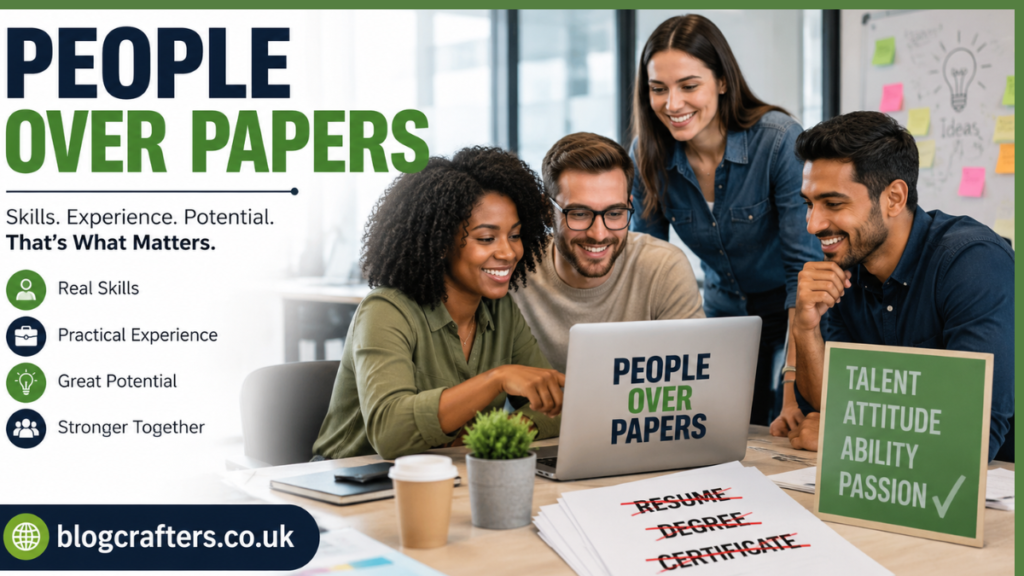
People over papers is a philosophy that prioritizes an individual’s abilities, experience, potential, and character over formal credentials such as degrees, certificates, or other documentation.
At its core, the movement argues that talent exists everywhere, but opportunities do not. Many capable individuals may lack access to higher education or expensive certifications, yet they possess valuable skills that can contribute significantly to organizations and communities.
The concept does not suggest that education is unimportant. Instead, it promotes a more balanced approach where qualifications are considered alongside practical abilities, work experience, problem-solving skills, communication, adaptability, and demonstrated achievements.
In today’s rapidly changing economy, employers increasingly recognize that real-world performance often provides a stronger indicator of success than traditional credentials alone.
The Origins and Evolution of People Over Papers
The idea behind people over papers is not entirely new. Historically, many trades and professions relied on apprenticeships, mentorships, and hands-on learning rather than formal education.
As industrialization expanded and universities became more accessible, credentials gained importance as standardized measures of competence. Employers used degrees and certifications to simplify recruitment and evaluate candidates.
However, the digital age introduced alternative ways to acquire knowledge. Online courses, self-directed learning, boot camps, professional communities, and practical experience created new pathways for skill development. As a result, many organizations began questioning whether degrees were always necessary indicators of capability.
The people over papers movement emerged from this changing landscape. It reflects growing recognition that talent can be developed through multiple avenues and that traditional educational paths represent only one route to professional success.
Why People Over Papers Is Gaining Attention
Several societal and economic trends have contributed to the rising popularity of people over papers.
One major factor is the increasing cost of higher education. Many individuals face significant financial barriers when pursuing degrees, leading organizations to reconsider whether formal education should remain the primary gateway to employment.
Another factor is the growing skills gap. Employers often struggle to find candidates with practical competencies despite receiving applications from individuals with impressive credentials. This mismatch has encouraged businesses to focus more heavily on demonstrated abilities.
The rise of remote work has also played a role. Global talent pools allow organizations to evaluate workers based on results rather than educational backgrounds. Performance and productivity frequently become more important than traditional credentials.
Additionally, technological change has accelerated the need for continuous learning. Many skills become outdated quickly, making adaptability and ongoing development more valuable than qualifications earned years earlier.
How People Over Papers Is Transforming Hiring Practices
Recruitment practices are undergoing significant changes as employers adopt people over papers principles.
Organizations increasingly emphasize skill assessments, portfolios, work samples, and practical tests during the hiring process. Rather than filtering candidates solely based on educational requirements, recruiters evaluate their ability to perform specific tasks.
This approach helps employers identify talented individuals who may have been overlooked by traditional hiring methods. Candidates with unconventional career paths often gain opportunities to demonstrate their value directly.
Skills-based hiring also improves workforce diversity. Removing unnecessary degree requirements can expand access to employment opportunities for people from different socioeconomic backgrounds, geographic regions, and educational experiences.
Many companies have discovered that focusing on capabilities rather than credentials leads to stronger employee performance, higher retention rates, and increased innovation.
Skills-Based Recruitment
Skills-based recruitment emphasizes measurable competencies instead of academic achievements alone.
Employers may use coding challenges, writing samples, project simulations, case studies, or technical assessments to evaluate candidates. These methods provide direct evidence of a person’s capabilities.
By focusing on practical performance, organizations can make more informed hiring decisions and reduce reliance on assumptions associated with educational backgrounds.
Portfolio-Driven Evaluation
Portfolios have become increasingly important in creative, technical, and professional industries.
A portfolio showcases real-world accomplishments, projects, and problem-solving abilities. It allows employers to assess tangible results rather than relying solely on credentials.
This approach aligns closely with the people over papers philosophy because it highlights demonstrated competence and practical expertise.
The Role of Skills-Based Employment
Skills-based employment represents one of the strongest manifestations of the people over papers movement.
Rather than asking where candidates studied, employers focus on what they can accomplish. This shift recognizes that learning occurs through many channels, including work experience, online education, volunteer activities, and independent projects.
Employees benefit from greater flexibility in career development. Individuals can build expertise through alternative learning pathways and still compete effectively in the job market.
Organizations also benefit because they gain access to larger talent pools. By removing unnecessary credential barriers, businesses can identify capable candidates who might otherwise be excluded from consideration.
The result is a more inclusive and efficient labor market that rewards demonstrated competence.
People Over Papers in Education and Learning
The influence of people over papers extends beyond employment and into education itself.
Educational institutions increasingly recognize that success involves more than obtaining credentials. Many schools now emphasize critical thinking, collaboration, creativity, communication, and practical problem-solving.
Alternative learning models have gained popularity as well. Online courses, micro-credentials, industry certifications, project-based learning, and experiential education provide diverse opportunities for skill acquisition.
Students are encouraged to build portfolios, complete real-world projects, and develop practical competencies that employers value.
This evolution reflects broader recognition that lifelong learning matters more than any single qualification. Continuous growth and adaptability have become essential characteristics in a rapidly changing world.
Alternative Learning Pathways
Alternative learning pathways allow individuals to acquire valuable skills outside traditional educational systems.
These options often offer greater flexibility, affordability, and accessibility than conventional degree programs.
As employers increasingly recognize alternative credentials and practical experience, learners gain more choices in pursuing professional development.
Lifelong Learning Culture
The people over papers movement supports a culture of continuous learning.
Rather than viewing education as something completed after graduation, individuals are encouraged to update their knowledge throughout their careers.
This mindset helps workers remain relevant and adaptable in evolving industries.
Benefits of the People Over Papers Philosophy
Supporters of people over papers highlight numerous advantages associated with the approach.
One significant benefit is increased access to opportunities. Individuals who lack formal credentials but possess strong abilities can compete more effectively for jobs and advancement.
The philosophy also promotes fairness by reducing barriers related to educational costs and unequal access to academic institutions.
Organizations benefit through improved talent acquisition. Expanding candidate pools allows employers to identify exceptional individuals who may have been overlooked under traditional hiring systems.
Innovation often increases as well. Diverse experiences and perspectives contribute to creative problem-solving and fresh ideas.
Additionally, employees may feel more motivated when performance and contributions receive greater recognition than credentials alone.
Challenges and Criticisms of People Over Papers
Despite its advantages, the people over papers philosophy faces criticism and practical challenges.
Some professions require extensive formal education due to safety, regulatory, or technical requirements. Fields such as medicine, engineering, law, and aviation depend on rigorous credentialing systems to protect public welfare.
Employers may also struggle to assess skills consistently without standardized qualifications. Evaluating candidates based solely on experience and portfolios can require more time and resources.
Another concern involves quality assurance. Credentials often serve as evidence that individuals have met established educational standards.
Critics argue that completely abandoning credential requirements could create inconsistencies in professional competence.
Supporters generally respond that the goal is not to eliminate credentials entirely but rather to use them appropriately while recognizing alternative indicators of capability.
Industries Embracing People Over Papers
Several industries have embraced people over papers more rapidly than others.
Technology stands out as a leading example. Many software developers, cybersecurity specialists, and digital professionals build successful careers through self-learning, coding boot camps, and practical experience.
Creative industries also emphasize portfolios and demonstrated talent. Designers, writers, photographers, and content creators frequently secure opportunities based on the quality of their work rather than educational backgrounds.
Entrepreneurship naturally aligns with people over papers principles because business success depends largely on execution, innovation, and leadership rather than formal credentials.
Skilled trades continue to value hands-on experience and practical competence, reinforcing the importance of demonstrated abilities.
As skills-based hiring expands, additional sectors are expected to adopt similar practices.
Latest Update on the People Over Papers Movement
The latest developments indicate growing momentum for people over papers across both public and private sectors.
Many employers have removed degree requirements from positions that previously demanded formal qualifications. Skills assessments, competency evaluations, and portfolio reviews are becoming more common during recruitment processes.
Educational providers are responding by offering flexible learning opportunities, industry-focused training programs, and micro-credential options that align with workforce needs.
The broader trend suggests a continued movement toward evaluating individuals based on measurable capabilities, practical achievements, and demonstrated potential.
This shift reflects changing attitudes about talent, learning, and professional success in the modern economy.
Reviews and Public Perception
Public opinion regarding people over papers is generally positive, particularly among job seekers and career changers.
Many individuals appreciate a system that recognizes practical skills and real-world accomplishments. The philosophy offers hope to talented people who may not have traditional educational credentials.
Employers often report positive outcomes when implementing skills-based hiring practices. Broader candidate pools and improved workforce diversity are frequently cited benefits.
However, some professionals remain cautious about reducing the role of credentials too dramatically. They emphasize the importance of maintaining standards, especially in highly specialized fields.
Overall, the movement is increasingly viewed as a balanced approach that combines respect for education with recognition of alternative forms of expertise.
The Future of People Over Papers
The future of people over papers appears promising as organizations continue to adapt to changing workforce demands.
Technological advancements are making skill verification easier through digital portfolios, project repositories, online assessments, and performance-based evaluations.
Employers are likely to adopt more sophisticated methods for measuring competence and potential. This evolution could reduce reliance on traditional educational requirements while improving hiring accuracy.
Educational institutions may also continue integrating practical experiences into curricula, helping students demonstrate capabilities alongside academic achievements.
As lifelong learning becomes increasingly important, the distinction between formal education and informal learning may continue to blur.
Ultimately, people over papers reflects a broader shift toward valuing human potential, adaptability, and demonstrated results.
Frequently Asked Questions
What does people over papers mean?
People over papers is a philosophy that prioritizes skills, experience, potential, and character over formal credentials when evaluating individuals.
Is people over papers against education?
No. The movement does not oppose education. It encourages balancing credentials with practical abilities and real-world performance.
Why is people over papers becoming popular?
The approach is gaining popularity due to rising education costs, skills shortages, alternative learning opportunities, and changing workforce needs.
Which industries support people over papers?
Technology, creative fields, entrepreneurship, digital marketing, skilled trades, and various service industries frequently embrace skills-based hiring.
Do credentials still matter?
Yes. Credentials remain important in many professions and can provide valuable evidence of knowledge and training.
How does people over papers benefit employers?
Employers gain access to larger talent pools, improve workforce diversity, and often identify highly capable candidates who might otherwise be overlooked.
Can self-taught professionals succeed under this philosophy?
Absolutely. Self-taught individuals can demonstrate their abilities through portfolios, projects, assessments, and professional achievements.
Will people over papers replace degrees completely?
Unlikely. Most experts believe the future will involve a balance between credentials and demonstrated skills rather than eliminating degrees entirely.
Conclusion
The people over papers movement represents a significant shift in how society evaluates talent, potential, and professional capability. Rather than relying exclusively on degrees and certifications, organizations increasingly recognize the value of skills, experience, adaptability, and real-world achievements.
While credentials continue to play an important role in many professions, the growing emphasis on demonstrated competence is creating new opportunities for individuals from diverse backgrounds. By focusing on what people can do rather than solely on the documents they possess, employers and educators can unlock broader talent pools and foster greater inclusion.
As skills-based hiring and lifelong learning continue to evolve, people over papers is likely to remain an influential philosophy shaping the future of work, education, and opportunity.